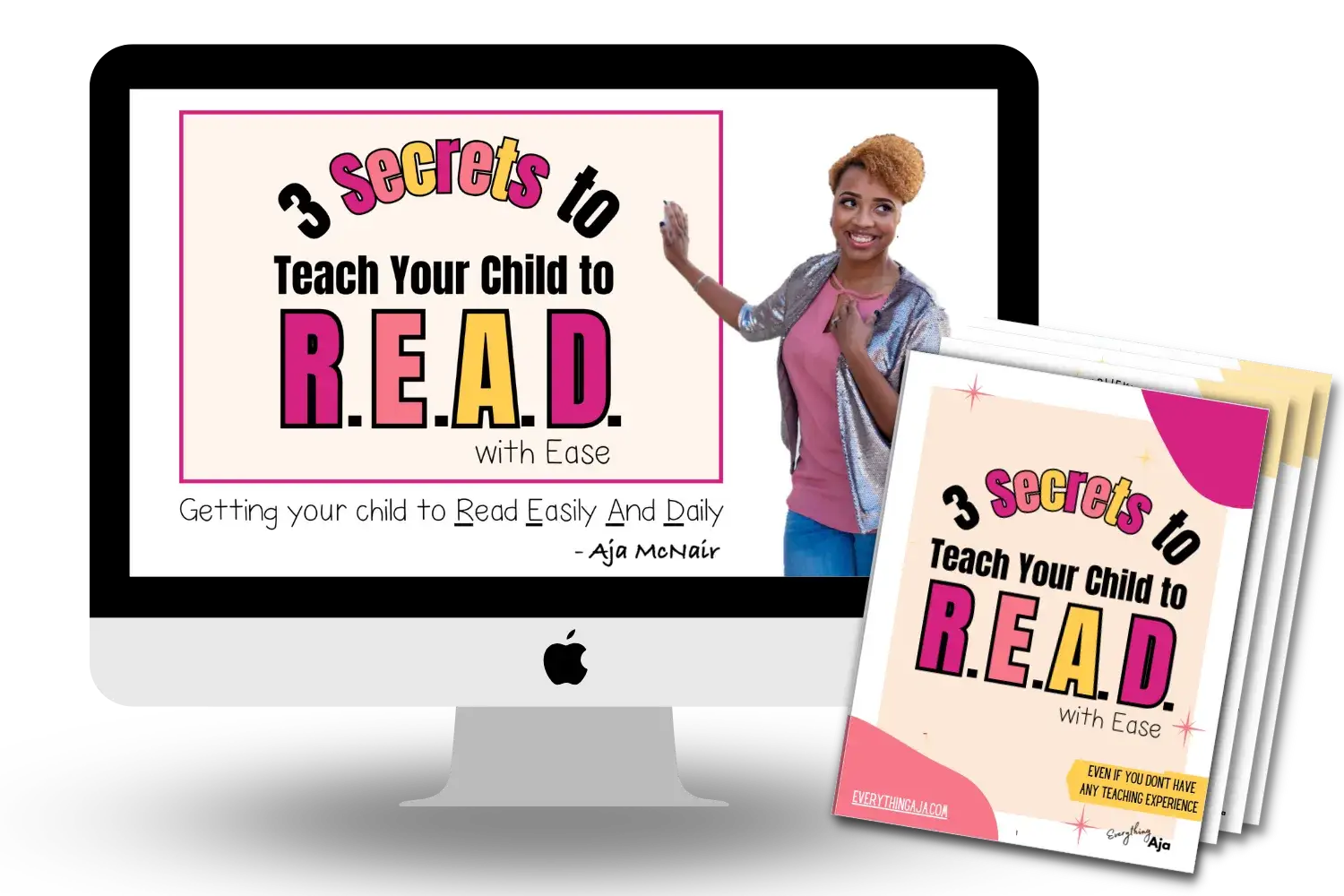
How to Teach Your Child to Read at Home: Where Do You Start?
Oct 29, 2026By Aja McNair
Have you ever sat down with your child to practice reading, only to discover that no matter how many times you explain a word, they still aren't getting it?
Maybe you've shown them the letters.
You've repeated the sounds.
You've pulled out the worksheets.
And eventually, you start wondering, "Am I even qualified to teach my child how to read?"
If you're homeschooling for the first time—or simply trying to help your child become a stronger reader—you don't have to figure out everything at once.
You need to know where your child is starting and what skill needs to come next.
That's one of the most important principles I want parents to understand about teaching reading.
You Don't Have to Teach All 26 Letters Before You Start Reading
When parents think about beginning reading instruction, it's easy to assume that the first goal should be teaching the alphabet from A to Z.
But learning to read is about much more than memorizing 26 letters.
Children have to learn that the letters they see represent the sounds they hear in spoken words. Then, they have to learn how to put those sounds together—or blend them—to read words.
This is why effective phonics instruction is systematic and explicit.
Instead of randomly introducing reading skills, we intentionally teach skills in a sequence so that one skill can build upon another.
And that means you can start small.
Start With a Small Group of Letter Sounds
Let's use three sounds as an example:
M
A
S
These are not the only three letters a child can begin with, and there are different research-based phonics sequences.
The bigger principle is this:
Introduce a manageable number of useful letter-sound correspondences and teach them accurately.
For example, /m/ and /s/ are continuous sounds.
You can say:
/mmmmmm/
and
/ssssss/
without adding another sound.
Then we can introduce the short A sound:
/a/ as in apple.
Starting with a small number of sounds gives your child an opportunity to focus on accuracy before adding more.
But there's something important parents need to know when modeling those sounds.
Don't Add the Extra "Uh"
Listen to the difference between these two sounds:
/mmmm/
and
/muh/.
Those aren't the same.
When I say /mmmm/, I'm producing the sound represented by M.
When I say /muh/, I've accidentally attached another vowel sound.
This happens frequently when adults model consonant sounds.
Instead of /t/, we say "tuh."
Instead of /p/, we say "puh."
Instead of /l/, we say "luh."
That additional sound can make blending more difficult because now the child is trying to combine sounds that aren't actually represented in the word.
For example, imagine trying to blend a word while hearing extra vowel sounds between every consonant.
We want to give children clean, accurate sound models that they can eventually blend together.
Then Move From Sounds to Blending
Knowing individual letter sounds is important, but that's not the end goal.
We want children to use their knowledge of sounds to read words.
Blending means taking the individual sounds in a word and combining them.
For example:
/s/ /a/ /t/
becomes:
sat.
This is where children begin applying what they've learned about letters and sounds to actual reading.
As you introduce additional sounds, the number of words your child can decode begins to grow.
And that's why the sequence you use matters.
We aren't simply collecting letter sounds.
We're building a reading system.
But Before You Decide What to Teach Next, Assess
This is where I want you to be careful.
You could read this article and immediately decide:
"Okay, Aja said we're starting with M, A, and S."
Not necessarily.
Those sounds are helping me demonstrate the process.
Your child may already know them.
Your child may know every basic letter sound but still struggle to blend.
Another child may be able to blend simple CVC words but struggle when the phonics patterns become more complex.
And another child may have foundational gaps that need to be addressed before moving forward.
That's why one of the most important things you can do before planning reading instruction is determine:
What does my child already know?
Where are the gaps?
What should I teach next?
Otherwise, you can spend weeks teaching something your child has already mastered—or move ahead while an important foundational skill is still missing.
Assess First. Then Teach With Intention.
This is exactly why I created the free Phonics to Phase Assessment.
Instead of guessing where to begin, the assessment helps you identify your child's current reading skills and determine where instruction needs to start.
Think of it this way:
Before we can create the roadmap, we need to know where we're standing.
Once you know your child's starting point, you can make much more intentional decisions about what to teach next.
So if you're wondering:
Where do I start teaching my child to read?
Your first step isn't trying to teach everything.
Your first step is finding out what your child already knows.
Then:
Assess.
Identify the gap.
Teach the next skill.
Build from there.
Teaching your child to read doesn't have to mean guessing your way through the alphabet.
You can teach systematically, intentionally, and one skill at a time.
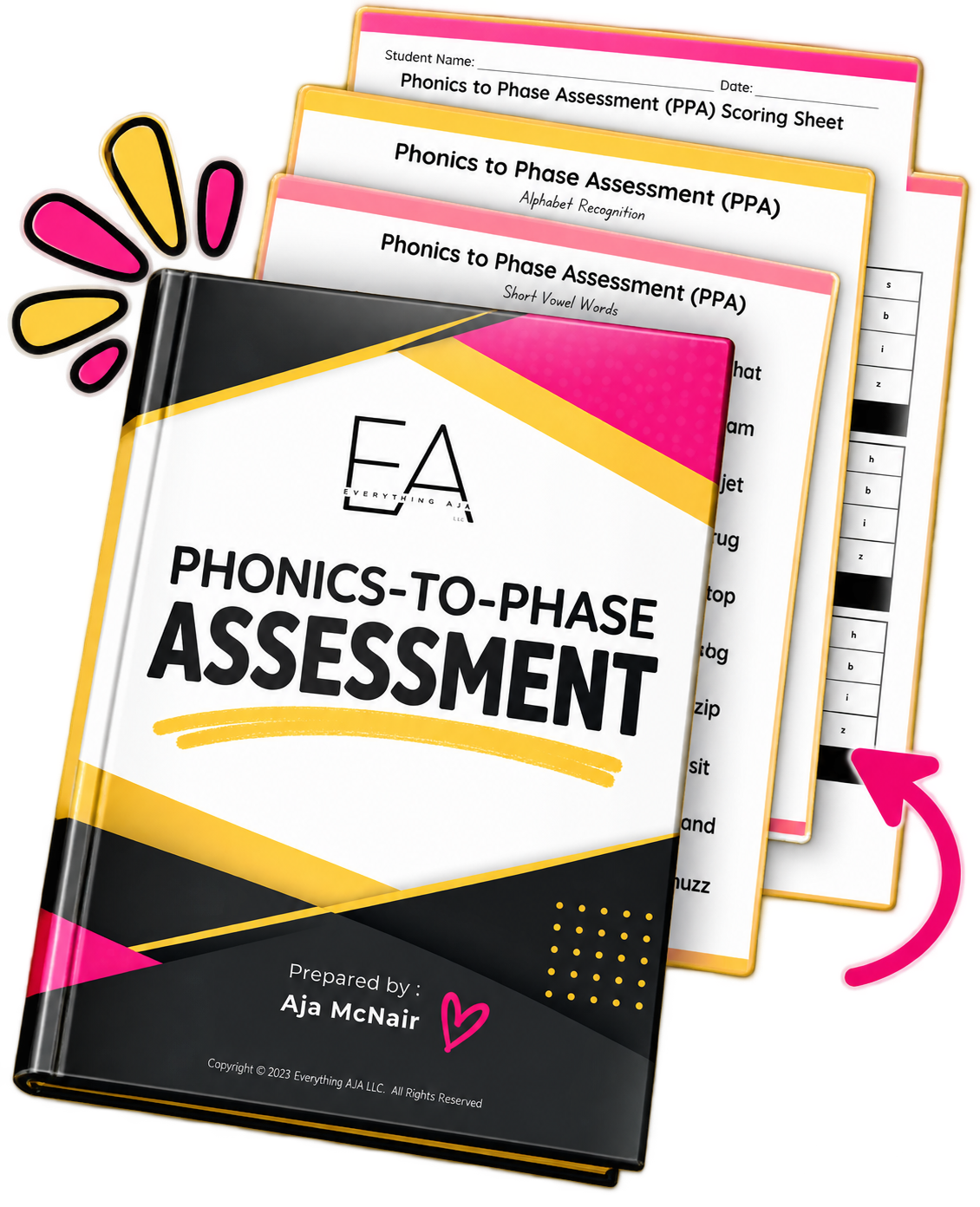
Ready to Find Your Child's Starting Point?
Download the FREE Phonics to Phase Assessment and discover what your child knows, where the gaps may be, and where you should begin.
Start with the assessment. Then you can create a reading plan based on what your child actually needs.
Lessen your stress by downloading my FREE Activity guide that features 3 activities that you can use with any lesson, standard or skill. In this FREE ebook, you will also get my FREE School Charades Icebreaker game.